
Tirzepatide Compounding Pharmacy Safety: How PCAB Stops Dosing Errors
Introduction: The Real Question Isn’t “Is It Legal,” It’s “Is It Safe”
GLP-1 medications have moved from niche prescriptions to mainstream treatment. According to Gallup fieldwork conducted in May and June 2026, 11% of U.S. adults (roughly 28 to 29 million people) currently use a GLP-1 for weight loss, up from just 3% in 2024. Within that group, about 18% to 19% rely on a compounded or custom-mixed version rather than a brand-name product.
Most of the content written for these patients answers one question: is compounded tirzepatide legal in 2026? That question matters, but it leaves a larger gap. Patients and prescribers still have little guidance on which documented safety risks a given pharmacy’s safeguards actually prevent.
This article closes that gap by matching FDA’s own 2026 data (more than 730 adverse event reports, documented 5x to 20x overdoses, and roughly 55 telehealth warning letters) against the specific pharmacy-level safeguards designed to address each risk.
It also corrects a persistent piece of misinformation. Some ranking and affiliate sites still claim that 503B outsourcing facilities are the superior source for tirzepatide. With 503B bulk tirzepatide compounding effectively closed in 2026, that advice is outdated. Today, accreditation, not facility type, is the meaningful safety differentiator. Choosing the right tirzepatide compounding pharmacy in 2026 requires understanding both the narrowed legal pathway and the specific safeguards that prevent documented harm.
What FDA’s Own 2026 Data Reveals About Compounded Tirzepatide Risk
As of May 31, 2026, the FDA had logged more than 730 adverse event reports tied to compounded tirzepatide and roughly 990 tied to compounded semaglutide, for a combined total exceeding 1,700. The agency has cautioned that the true number is likely higher, because adverse event reporting is not mandatory in every setting where these drugs are sold, including many telehealth platforms, med spas, and direct-to-consumer sellers.
The foundation for every safeguard discussed below comes from FDA’s own consumer guidance: compounded drugs are not FDA-approved, and the agency does not review their safety, effectiveness, or quality before they are marketed. Every quality measure a compounding pharmacy adopts exists to offset that gap.
The Dominant Safety Signal: Dosing Errors, Not Contamination
The most prominent pattern in the data is not contamination. It is dosing error. FDA and clinical reports describe patients receiving 5 to 20 times their intended dose, most often from multi-dose vials that require patients to measure each injection themselves.
The mechanism is specific. Many patients draw compounded tirzepatide using insulin syringes marked in “units,” while their prescriptions are written in milligrams. When the conversion between units and milligrams is unclear, patients can self-administer a significant overdose. Some of these cases have required hospitalization.
This is primarily a measurement and instruction failure, not necessarily a drug-quality failure. That distinction matters, because it points directly to the fix: clear, standardized dosing instructions.
The Marketing Signal: Telehealth Warning Letters
In 2026, the FDA sent roughly 55 warning letters to telehealth companies, 30 in March and 25 in June, for false or misleading marketing that implied compounded GLP-1s were equivalent to FDA-approved drugs. In August and September 2026, the agency issued additional letters to sellers of “research use only” semaglutide, tirzepatide, and retatrutide, a related but distinct red-flag category.
For patients, misleading marketing creates real risk. It blurs the compounded-versus-approved distinction that people need to make informed treatment decisions.
The Legal Narrowing: Why 503A Patient-Specific Compounding Is Now the Only Lawful Pathway
Affiliate content still recommending “503B-only” tirzepatide sources describes a pathway that is effectively closed. The following timeline shows how the legal landscape narrowed.
From Shortage Resolution to Enforcement Discretion Expiration
- October 2, 2024: FDA declared the tirzepatide injection shortage resolved.
- December 19, 2024: FDA reaffirmed that finding after a litigation-triggered reconsideration.
- February 18, 2025: Enforcement discretion expired for 503A pharmacies.
- March 19, 2025: Enforcement discretion expired for 503B outsourcing facilities.
After these dates, routine bulk compounding became presumptively non-compliant absent documented patient-specific justification. The Outsourcing Facilities Association challenged FDA in court, but a Texas federal judge denied its preliminary injunction on March 5, 2025, and ruled on the merits on May 7, 2025, that FDA acted within its statutory authority.
The April 2026 Bulks List Exclusion and the August 2026 Fifth Circuit Ruling
On April 30, 2026 (Federal Register docket 2026-08552), FDA proposed permanently excluding semaglutide, tirzepatide, and liraglutide from the 503B Bulks List based on a “no clinical need” finding. If finalized, 503B compounding of these drugs would remain closed even if a future shortage occurs.
On August 27, 2026, the Fifth Circuit Court of Appeals affirmed FDA’s position in both the tirzepatide and semaglutide shortage-resolution cases, closing the judicial appeal route. The net effect is that 503B bulk tirzepatide compounding is durably closed, not temporarily paused.
What’s Actually Left: Narrow, Patient-Specific 503A Compounding
As of November 2026, the only lawful pathway is 503A compounding in which a licensed prescriber documents an individualized clinical need that an FDA-approved product cannot meet. FDA’s own guidance notes that a compounded drug may be appropriate when a patient’s medical need cannot be met by an approved drug.
This exception was not designed for routine, protocol-based prescribing to support telehealth weight-loss volume. The practical takeaway is direct: the 503A-versus-503B label is no longer the meaningful safety signal it once was. Accreditation and compliance practices within a 503A pharmacy are now what patients and prescribers should evaluate.
Risk-by-Risk: How Pharmacy Safeguards Are Designed to Prevent Each Documented Harm
This is the core of the evaluation. Each subsection pairs one FDA-documented risk with the safeguard engineered to address it. The framework applies to any pharmacy under consideration.
Risk: Unit/Dosing Confusion Leading to 5x-20x Overdoses → Safeguard: Standardized Dosing Instructions
The FDA’s documented overdose pattern stems from ambiguity between syringe units and milligram doses. The targeted fix is dosing instructions that state exactly what to draw, in terms that match the syringe the patient is using, alongside patient education materials that explain the conversion.
Consistent vial labeling, clear dosing charts, and prescriber-reviewed instructions all reduce the chance of self-administration error. Standardized instructions also protect prescribers by closing documentation gaps that could otherwise expose them to liability if a patient misdoses.
Risk: Compounding Environment Contamination → Safeguard: USP 800 Compliance
USP General Chapter <800> is the now-enforceable standard governing the handling of hazardous drugs in pharmacy settings. Compliance requires defined facility controls, handling procedures, and personnel protections that reduce the risk of contamination, cross-contact, and environmental exposure during preparation. Importantly, USP compliance is something PCAB verifies during accreditation rather than a claim a pharmacy simply declares.
Risk: Unverified Potency/Purity → Safeguard: Independent Third-Party Testing
Because FDA does not verify compounded drug quality before marketing, independent third-party lab testing becomes the pharmacy’s own accountability mechanism. Testing confirms that a preparation contains the labeled amount of active ingredient and is free of unacceptable impurities.
This matters directly in light of the dosing data. A super-potent batch can amplify the effect of a measurement error, while a sub-potent batch can undermine treatment. Independent testing catches these problems before dispensing, which is a meaningfully higher bar than internal-only checks that some non-accredited competitors rely on.
Risk: Substandard or Unverified Raw Material Sourcing → Safeguard: FDA-Cleared Vendor Sourcing
The quality of a compounded medication begins with its active pharmaceutical ingredient (API). API from unregulated or unverified suppliers, including the “research use only” sellers flagged in FDA’s 2026 warning letters, carries unknown identity, purity, and potency. Sourcing exclusively from FDA-inspected and cleared vendors closes this gap at the supply-chain level, before compounding even begins.
Risk: Lack of Independent Oversight → Safeguard: PCAB Accreditation
PCAB accreditation is the umbrella safeguard that verifies the other safeguards are actually being followed. No federal law requires it. A pharmacy that holds it has voluntarily invited independent third-party scrutiny that non-accredited competitors have not.
That choice is uncommon. According to patient materials published by one accredited pharmacy, fewer than 3% of U.S. compounding pharmacies have achieved PCAB accreditation, which makes it one of the clearest trust signals available.
Risk: Misleading Marketing Obscuring Compounded-vs-Approved Status → Safeguard: Transparent, Compliant Disclosure
The roughly 55 telehealth warning letters issued in 2026 targeted marketing that implied equivalence to FDA-approved drugs. A compliant pharmacy’s communications should affirmatively disclose that compounded tirzepatide is not FDA-approved, consistent with FDA’s consumer guidance.
Prescriber documentation is part of this safeguard. When a prescription reflects a documented, individualized clinical need rather than generic weight-loss volume, it guards against the “essentially a copy” problem the law is designed to prevent.
What PCAB Accreditation Specifically Verifies
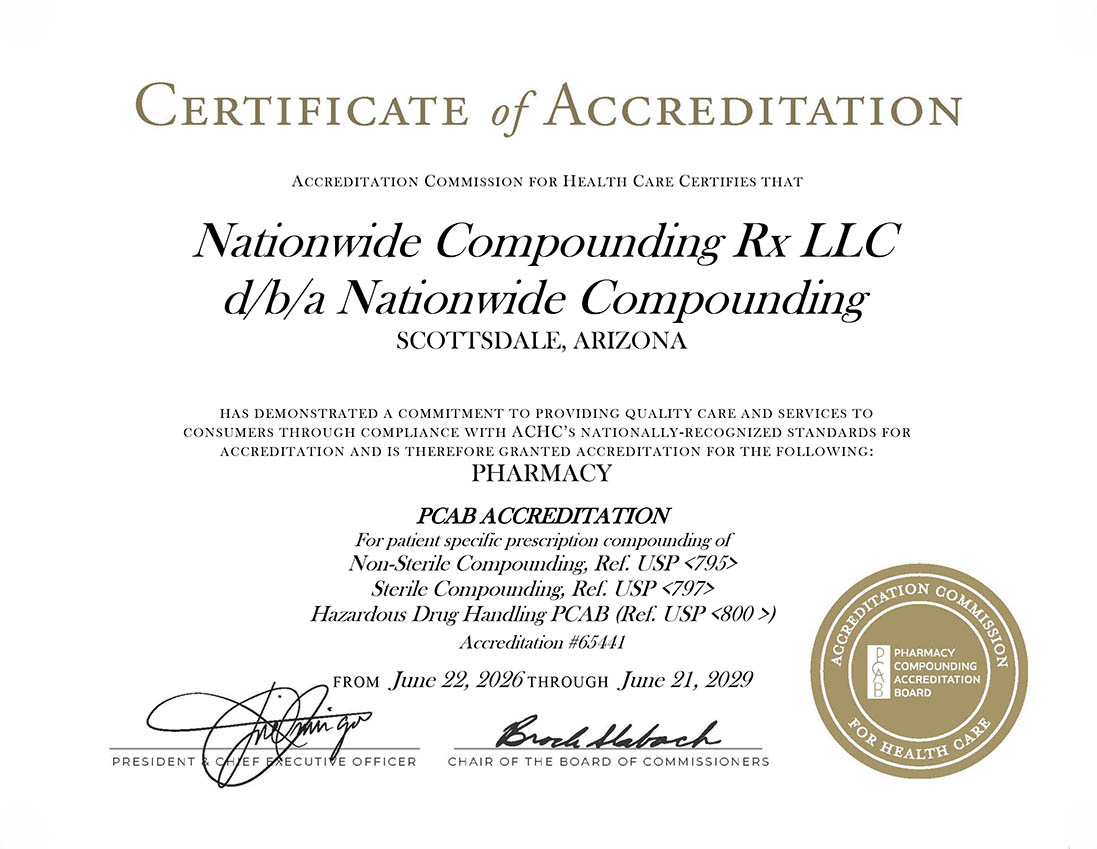
PCAB, now operated as a service of ACHC (Accreditation Commission for Health Care), confirms that a compounding pharmacy complies with:
- USP <795>: standards for non-sterile compounding
- USP <797>: standards for sterile compounding, the category that includes injectable preparations
- USP <800>: the now-enforceable standard for hazardous drug handling
Accreditation is an ongoing, auditable status rather than a one-time credential. Pharmacies must demonstrate documented processes and maintain them over time. Because PCAB is voluntary, pursuing it signals a deliberate decision to accept scrutiny beyond state licensing minimums. That is precisely why it functions as a differentiator.
A Related but Separate 2026 Policy: The HHS Peptide Enforcement Discretion List
On October 28, 2026, HHS issued a draft Enforcement Discretion Policy allowing 503A compounding of six specific peptides under 10 conditions: BPC-157, Epitalon, KPV, MOTS-c, Semax, and TB-500.
Tirzepatide is not on this list. The policy does not reopen or loosen tirzepatide compounding rules in any way.
This clarification matters because headlines suggesting that “peptides are becoming easier to compound” can easily be conflated with tirzepatide’s status. Tirzepatide remains subject to the stricter, narrow patient-specific standard described above.
Why Accredited Compounding Still Matters Despite the Narrower Pathway
Cost continues to drive interest in compounded options. Branded Zepbound cash-pay pricing through LillyDirect runs about $299 per month at the 2.5 mg dose and roughly $449 to $699 per month at higher maintenance doses, while full retail list price sits around $1,060 to $1,086 per month.
The Medicare “GLP-1 Bridge” program (July 2026 through December 2027) offers eligible Part D enrollees access to certain GLP-1 products for a flat $50 per month. That may reduce compounded demand among Medicare-eligible patients, but many other patients remain cost-constrained.
Manufacturer pressure is also rising. Eli Lilly has independently pursued legal action against compounding pharmacies and med spas over alleged unlawful tirzepatide sales and misuse of its branding, adding another layer of scrutiny for non-compliant operators.
For patients with a legitimate, documented clinical need, an accredited, narrowly compliant 503A pharmacy represents a credible middle path: neither the uncritical cheap option nor the brand-only option.
A Practical Checklist: How to Vet a Tirzepatide Compounding Pharmacy in 2026
For patients and prescribers:
- [ ] Confirm current PCAB accreditation status
- [ ] Ask about USP <800> compliance (and <797> for sterile injectables)
- [ ] Request evidence of independent third-party potency and purity testing
- [ ] Confirm raw materials come from FDA-inspected and cleared vendors
- [ ] Review dosing instructions for clarity on units versus milligrams
For prescribers specifically:
- [ ] Document the individualized clinical need per the narrow 503A standard, not a generic weight-loss protocol
Marketing red-flag check:
- [ ] Does the pharmacy or telehealth partner clearly disclose that compounded tirzepatide is not FDA-approved?
Where Nationwide Compounding Rx® Fits This Standard
Nationwide Compounding Rx®, based in Scottsdale, Arizona, is PCAB-accredited and USP 800 compliant, which maps directly to the oversight and preparation safeguards outlined above. The pharmacy produces both sterile and non-sterile formulations.
Its quality practices address the raw-material and potency risks covered earlier: the pharmacy uses independent third-party testing and sources high-grade chemicals exclusively from FDA-inspected and cleared vendors.
The pharmacy’s GLP-1/Peptide Support service line is positioned within the narrow, patient-specific 503A framework, working with prescribers through a secure Provider Portal for prescription submission and order tracking. Its partnership model, Connect, Collaborate, Create, Care, provides the operational structure for working alongside prescribers to support appropriate documentation of individualized clinical need.
Once safety and legal trust are established, practical factors also matter. Nationwide Compounding Rx® offers a 1 to 2 business day turnaround and nationwide shipping to states where it is licensed, with availability varying by medication type and state regulations.
Conclusion: Safety in 2026 Is About Safeguards, Not Facility-Type Labels
FDA’s own 2026 data points to specific, identifiable risks: dosing confusion, sourcing gaps, unverified potency, and misleading marketing. For each one, a specific pharmacy safeguard exists to address it directly.
The legal reality is also clearer than much of the content online suggests. After the April 2026 Bulks List proposal and the August 2026 Fifth Circuit ruling, 503B bulk tirzepatide compounding is effectively closed, and narrow 503A patient-specific compounding is the only lawful pathway.
Within that pathway, accreditation is what separates a safety-literate compounding pharmacy from the rest. For cautious patients and liability-conscious prescribers alike, informed vetting is the most effective tool for navigating this narrowed landscape.
Work With a PCAB-Accredited 503A Pharmacy Built for This Standard
Patients are encouraged to apply the checklist above to any pharmacy they evaluate, and to consider Nationwide Compounding Rx® as a PCAB-accredited, USP 800-compliant option.
Prescribers and clinics can connect through the Provider Portal to discuss documented clinical-need compounding and a GLP-1/Peptide Support partnership.
Contact Nationwide Compounding Rx®:
- Phone: (480) 499-8379
- Website: nationwidecompounding.com
- Address: 14000 N. Hayden Rd., Suite 104, Scottsdale, AZ 85260
- Hours: Monday through Friday, 7:00 AM to 3:30 PM
- Email inquiries: Answered within one business day via the website contact form
Patients and providers are invited to reach out directly to discuss individual needs or explore a compliant, safety-focused compounding partnership.
Related Posts
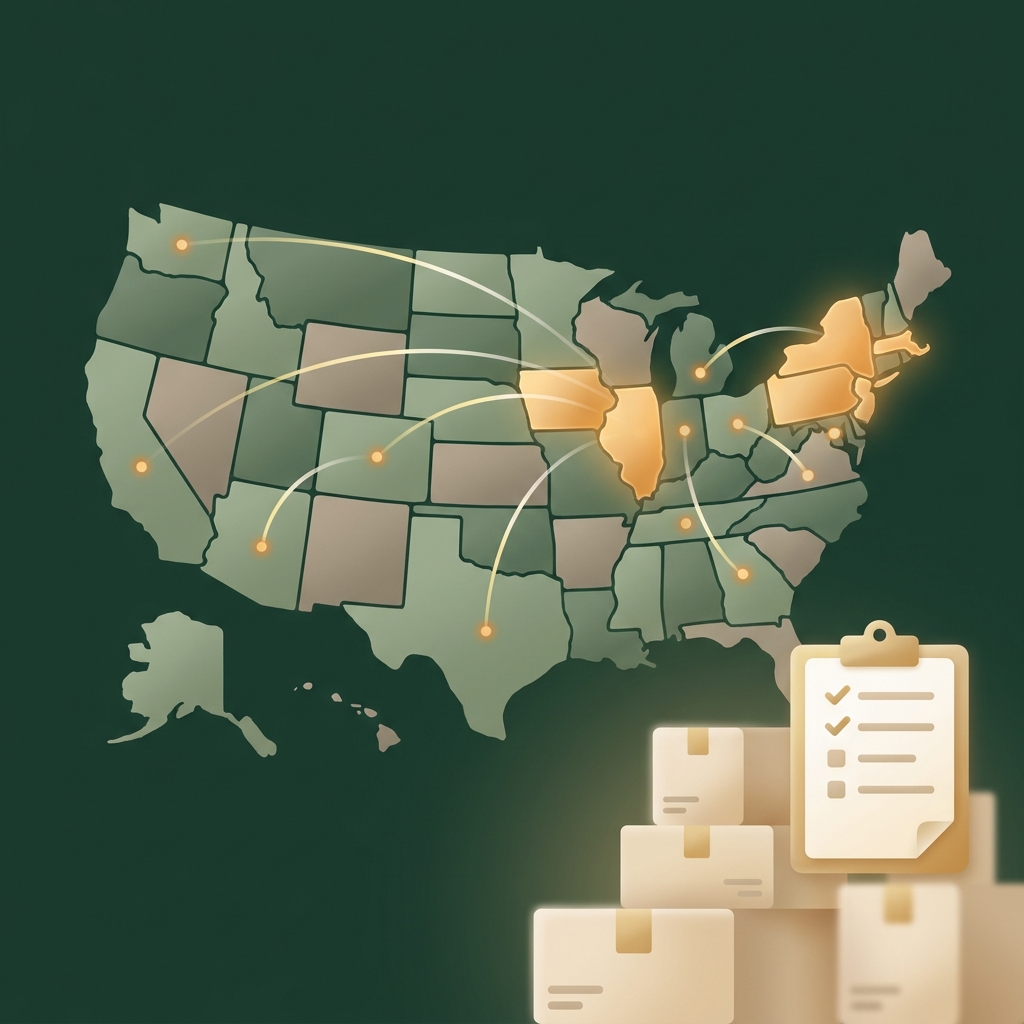
Before transferring a prescription to Pencol Compounding Pharmacy, find out if this Denver-based pharmacy can legally ship to your state. We break down its documented 13-state shipping footprint and what Section 503A rules mean for your order in 2026.

Searching for CareFirst Specialty Pharmacy can lead to three unrelated businesses: CareFirst BlueCross's ESPN network, an independent New Jersey compounder, and a Charlotte community pharmacy. This guide explains how to tell them apart and navigate BHRT coverage gaps in 2026.

Choosing a compounding pharmacy in Asheville NC requires more than hometown branding—it demands legal verification. This 2026 guide walks through North Carolina's pharmacy statutes, USP <797>/<800> enforcement, and how to use the NCBOP's online portal to confirm a pharmacy's license before trusting it with your prescription.

Choosing between BHRT pellets, creams, troches, and capsules can feel overwhelming without clear facts. This 2026 guide compares how each delivery method works, what the FDA and NASEM research says, and why pharmacy quality matters most when evaluating BHRT pellets.