The Art of Compounding Pharmacy: From Ancient Apothecary to Modern Precision Rx
Introduction: When Medicine Was a Craft
Imagine a Babylonian healer around 2600 BC, pressing careful cuneiform symbols into wet clay. On that tablet, the healer records a patient’s symptoms, lists the ingredients gathered for treatment, and notes the exact directions for preparing a remedy no one else could provide. This was not a generic prescription. It was a formulation made for one person, by hand, with intention.
That scene captures a truth that has held for more than four thousand years: pharmaceutical compounding has always been both an art and a science. This dual identity is not a marketing slogan. It is a 4,600-year lineage. In fact, the discipline is formally described, in regulatory and academic contexts, as “the art and science of preparing personalized medications tailored to meet the individual needs of each patient.” Patents, peer-reviewed journals, and industry associations all use this framing.
This article traces the journey of that craft: from ancient apothecaries through Galenic medicine, into the American apothecary era, past the disruption of mass manufacturing, and finally to the modern precision renaissance embodied by PCAB-accredited pharmacies like Nationwide Compounding Rx®. One striking fact anchors the journey: roughly 135 million compounded prescriptions are dispensed annually across the United States today. The craft never disappeared. It evolved.
The Ancient Roots: Apothecaries, Clay Tablets, and the First Compounders
The earliest documented compounding traces to those Babylonian clay tablets. These were not one-size-fits-all remedies. They were individualized formulations, complete with recorded symptoms and specific preparation directions for a particular patient.
Egyptian, Greek, and Roman traditions carried the practice forward. In each, the apothecary emerged as a specialized healer-craftsperson: someone who identified, sourced, and combined natural ingredients into personalized remedies. The pivotal figure in this story is the Greek physician Claudius Galen (130 to 200 AD). Galen is credited with formalizing compounding, developing a systematic approach to mixing multiple drugs to meet individual patient needs. His method is the direct ancestor of modern pharmaceutical compounding.
Becoming an apothecary demanded extraordinary dedication. Practitioners trained through seven-year apprenticeships, learning to identify and prepare hundreds of substances and to master patient-specific formulation. They were, in the truest sense, artisans of medicine.
That depth of expertise has not faded. Today’s compounding pharmacists average 19 years of experience, according to the APC 2025–2026 Snapshot of Pharmacy Compounding in America. The knowledge required has not diminished; it has deepened. And here is the historical bedrock: before the FDA existed, compounding was the only way medications were made. Every prescription was a bespoke creation.
The American Apothecary Era: Craft at the Heart of a New Nation
The American tradition has a clear anchor point. The first U.S. pharmacy opened in Philadelphia in 1720. In colonial and early American society, compounding pharmacists ranked among the most skilled and respected craftspeople.
The apothecary shop functioned as a center of community health. The pharmacist knew each patient by name, understood their history, and prepared remedies tailored to their specific needs. It was a relational model of care, one that mass manufacturing would later disrupt. Formalization followed: the Apothecaries Act of 1815 helped establish a craft standard, setting a historical precedent for the accreditation systems that govern the profession today.
Then came the twentieth-century disruption. The rise of mass-manufactured pharmaceuticals sidelined personalized compounding, replacing the artisan model with industrial standardization. Efficiency was gained, but patient individuality was sacrificed. Yet compounding never disappeared. It persisted for the patients who fell outside the one-size-fits-all model: children, those with allergies, and people who needed discontinued formulations. Today the pendulum is swinging back, driven by personalized medicine, pharmacogenomics, and a growing recognition that not every patient fits a standard dose.
Why the Art Never Died: The Patients Mass Manufacturing Left Behind
Mass-manufactured pharmaceuticals share one fundamental limitation: they are designed for the average patient. But no patient is average.
Consider the populations that industrial standardization cannot serve well:
- Pediatric patients who need age- and weight-specific doses in palatable forms
- Patients with allergies to dyes, fillers, or preservatives found in commercial products
- Patients requiring discontinued drug strengths no longer manufactured
- Patients whose genetics make standard doses ineffective or even harmful
That last point now carries real scientific weight. Real-world data published in Pharmacogenetics and Genomics in March 2026 identified an average of 4.7 actionable genetic variants per patient, with drug-gene interactions found in 46% of patients. Nearly half of all patients carry genetic factors that affect how they respond to medication.
The results of matching medication to patient are measurable. Over 70% of patients receiving compounded medications reported improved adherence compared to conventional therapies, according to an IACP survey. The art produces clinical outcomes.
This aligns with a much larger trend. The global personalized medicine market was valued at USD 393.9 billion in 2025 and is projected to reach USD 779.4 billion by 2036. More than 25% of new FDA-authorized drugs are now tailored or personalized medicines. The industry is moving toward compounding’s founding philosophy, not away from it.
The Craft Defined: What the Art of Compounding Actually Involves
Compounding is not simply mixing ingredients. It is a deliberate, skilled process of selecting, measuring, combining, and verifying pharmaceutical-grade substances to create a medication that exists in no commercial form.
Each formulation involves a series of craft decisions: choosing the right active pharmaceutical ingredients, selecting the appropriate base or vehicle, determining the optimal dosage form (capsule, topical, troche, suppository, or flavored liquid), and calibrating strength to the individual patient.
Flavor and form are genuine expressions of that craft. In pediatric compounding especially, a child’s willingness to take a medication can determine whether treatment succeeds. Options like cherry, bubblegum, and piña colada are not trivial; they are patient-centered design. So is allergen-free formulation. Removing dyes, fillers, preservatives, and allergens while preserving therapeutic efficacy is not subtraction; it is reconstruction, and it requires deep formulation knowledge.
The scale of this creative output is substantial. Compounding pharmacies prepare approximately 100 unique formulations weekly, per the APC Snapshot. Each one is a distinct creation for a specific patient. Bioidentical hormone replacement therapy illustrates the living nature of the craft: at Nationwide Compounding Rx®, BHRT formulas are adjustable at each refill based on updated lab results, an iterative process that responds to the patient’s changing biology.
The Compounding Pharmacist as Artisan: Skill, Knowledge, and Relationship
The compounding pharmacist is not a dispenser. This is a skilled craftsperson whose expertise spans chemistry, pharmacology, patient physiology, and formulation science.
The data confirms the mastery involved. Compounding pharmacists average 19 years of experience, and technicians average more than 12 years. This is not entry-level work. Just as a master glassblower or luthier develops intuition through years of hands-on practice, the compounding pharmacist develops formulation judgment that no checklist can capture.
The craft is also collaborative. It operates within a triad of patient, prescriber, and pharmacist, each contributing essential knowledge. This is the “Connect, Collaborate, Create, Care” model in action. These are ongoing relationships, not one-time transactions: the median 503A compounding pharmacy collaborates with roughly 150 prescribers. And the role is expanding. As genomic data becomes clinically actionable, the compounding pharmacist increasingly interprets genetic variants and designs formulations that account for individual drug metabolism, a forward-looking dimension of the craft.
Modern Precision: How Technology Serves the Art
A key principle guides the modern practice: technology does not replace the art of compounding. It makes the art reliably reproducible. As Nationwide Compounding Rx® frames it, technology serves patients “by making the art of compounding reliably reproducible.”
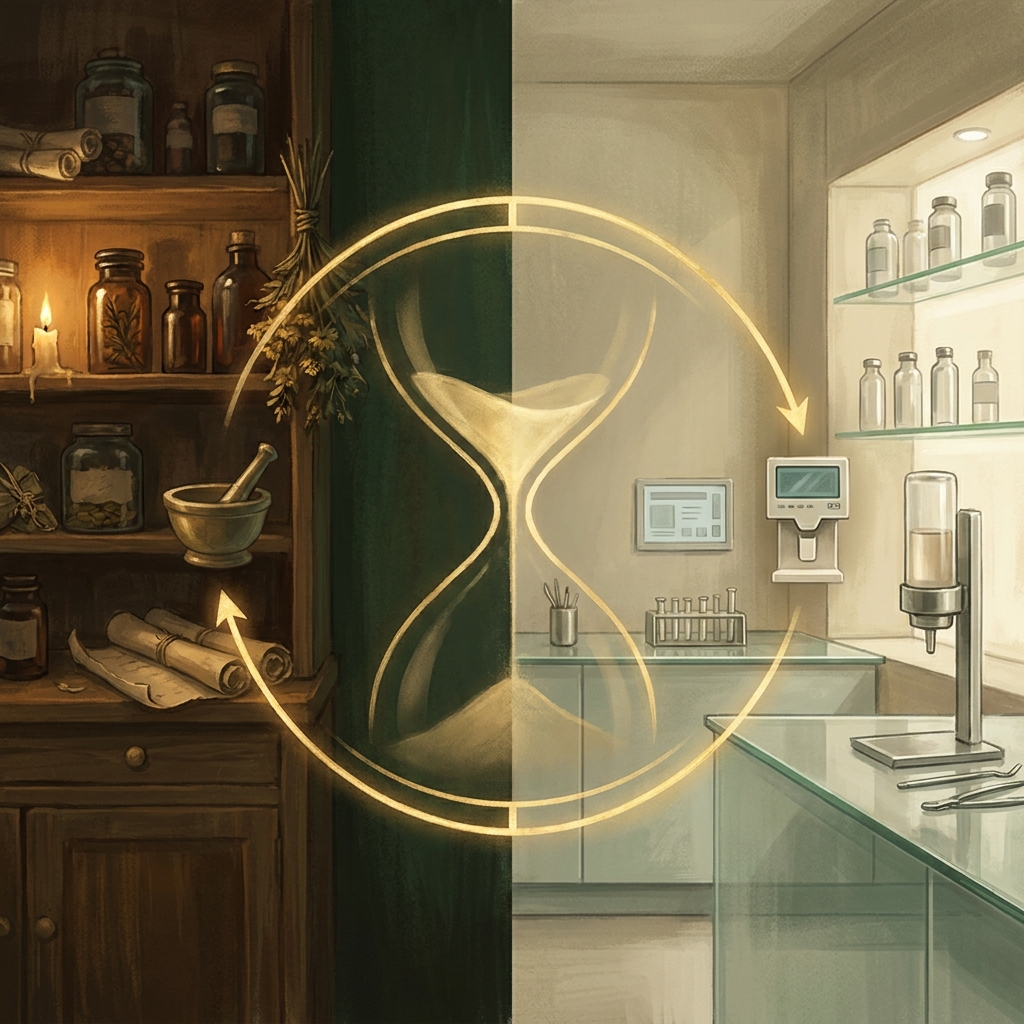
The modern compounding environment reflects this. USP-compliant cleanrooms, high-tech analytical equipment, robotic dispensing systems, and AI-assisted formulation tools all serve the same patient-specific goal that Galen pursued with mortar and pestle. Perhaps the most dramatic example is 3D printing. A 2025 peer-reviewed study demonstrated that automated 3D printing-based compounding platforms significantly enhanced precision, efficiency, and adaptability in pediatric corticosteroid formulations. The 3D printed drugs market is projected to expand at a 9.8% CAGR from 2026 to 2036.
Quality assurance is the contemporary craft standard: independent third-party testing, sourcing from FDA-inspected and cleared vendors, and a 1 to 2 business day turnaround without sacrificing precision. USP Chapters <795>, <797>, and <800> are not bureaucratic boxes to check. They are the modern codification of the craft standard, with 2022 revisions enforced by 2026 that raised cleanroom and quality requirements. Technology also serves as a supply-chain safety net: more than half of compounding pharmacies reported compounding copies of FDA-approved drugs during active drug shortages, according to the APC Snapshot.
The Gold Standard of Craft: PCAB Accreditation and What It Signals
PCAB accreditation, granted by the Pharmacy Compounding Accreditation Board, is the modern equivalent of the master craftsperson’s guild certification. It is a rigorous, externally validated standard that fewer than 1% of U.S. pharmacies achieve.
Earning it requires adherence to USP <795>, <797>, and <800> standards, cleanroom compliance, staff training, quality systems, and ongoing inspection. It is not a one-time credential but a sustained commitment to excellence. The endorsement carries institutional weight: the American Medical Association recommends that physicians use only PCAB-accredited compounding pharmacies when prescribing compounded medications.
This matters more than ever. The semaglutide and tirzepatide compounding controversy, followed by the FDA’s 2026 enforcement crackdown, has intensified public scrutiny of compounding quality. As Pharmacy Times analysis notes, PCAB accreditation functions as “a safeguard for consistency, oversight, and public trust.” It separates legitimate artisan compounders from mass-market operators. For Nationwide Compounding Rx®, PCAB accreditation and USP 800 compliance are not checkboxes; they are the modern expression of a 4,600-year craft standard. The ACHC describes PCAB as the internationally recognized benchmark for excellence in compounding practice, the craft guild seal of the modern era.
The Resurgence: A $20 Billion Craft Industry Reclaiming Its Place
The market data reveals a cultural and clinical recalibration. IBISWorld places the U.S. compounding pharmacy market at $20.2 billion in 2026, with a 10.4% CAGR between 2021 and 2026. The artisan model is not a niche; it is a major and growing sector.
Globally, the compounding pharmacy market is valued at roughly $15.83 to $16.78 billion in 2025 and 2026 and is forecast to reach $22.08 billion by 2031. Within this growth, hormone replacement therapy is the fastest-growing specialty, projected at a 7.86% CAGR from 2026 to 2031, precisely where craft-level customization such as adjustable BHRT is clinically essential. Oral medications lead product categories with roughly 45% market share in 2026, while topical medications are growing fastest; both are areas where formulation craft is a direct patient-experience differentiator. Notably, 503A pharmacies (the traditional patient-specific model) dominate the U.S. market with 65% to 73% of revenue share.
Nationwide Compounding Rx® sits squarely within this resurgence: a PCAB-accredited, multi-state pharmacy with 40 or more years of combined team experience, serving patients across specialties from BHRT to pediatrics to pain management.
Nationwide Compounding Rx®: Where the Tradition Lives Today
Nationwide Compounding Rx® is not a transactional pharmacy. It is a contemporary expression of the compounding craft tradition, serving both healthcare providers and patients across the country.
Its craft capabilities span distinct formulation disciplines: BHRT, pain management, dermatology, pediatrics, sports medicine, and GLP-1 and peptide support. The breadth of dosage forms reflects the art in action: capsules, liquids, topicals, troches, lozenges, tablets, sublingual preparations, suppositories, and pediatric-specific forms including flavored popsicles and suckers. Available flavors include cherry, peppermint, raspberry, strawberry, tutti frutti, marshmallow, orange, bubblegum, and piña colada, with additional and animal-friendly options as well.
The pharmacy’s allergen-free capability rebuilds medications from the ground up, producing formulations free of dyes, fillers, preservatives, and allergens. Its quality infrastructure supports the craft: high-grade active ingredients sourced exclusively from FDA-inspected and cleared vendors, independent third-party testing, PCAB accreditation, and USP 800 compliance. The modern cleanroom is the contemporary apothecary workshop.
The relational dimension endures through the Connect, Collaborate, Create, Care model. The pharmacy works alongside prescribers and patients as a skilled partner, not a vendor. Operational details reflect patient-centered design: 1 to 2 business day turnaround, same-day pickup for select medications, and nationwide shipping (availability varies by state and medication type), supported by secure portals for both providers and patients.
Frequently Asked Questions About the Art of Compounding Pharmacy
What does “the art of compounding pharmacy” actually mean?
It is the formal, regulatory, and academic description of pharmaceutical compounding as a discipline that combines scientific precision with skilled, hands-on craftsmanship to create individualized medications. The USPTO, peer-reviewed literature, and industry associations all use this framing.
How is compounded medication different from a regular prescription?
A compounded medication is created specifically for one patient, in the right strength, dosage form, flavor, and ingredient profile for that individual. A commercial prescription is manufactured for the average patient in standardized forms.
Is compounding pharmacy safe?
Yes, when performed by accredited, compliant pharmacies. PCAB-accredited pharmacies (fewer than 1% of all U.S. pharmacies) meet the highest quality standards, including USP <795>, <797>, and <800> compliance, third-party testing, and FDA-cleared ingredient sourcing.
Who needs a compounded medication?
Patients who need a non-standard dose, a different dosage form (such as a topical instead of a pill), an allergen-free formulation, a pediatric-friendly flavor, a discontinued medication, or a formulation informed by their genetic profile. Learn more about when you should use a compounding pharmacy.
What is PCAB accreditation and why does it matter?
PCAB is the Pharmacy Compounding Accreditation Board’s gold-standard credential, held by fewer than 1% of U.S. pharmacies. The AMA recommends physicians use only PCAB-accredited pharmacies. It signals that a pharmacy meets the highest craft and quality standards in the industry.
How do I get a compounded medication from Nationwide Compounding Rx®?
Through a prescriber who submits a prescription via the Provider Portal, or by contacting the pharmacy directly to discuss individual needs and connect with a provider. The pharmacy ships nationwide, with availability varying by state and medication type.
Conclusion: The Art Endures, and So Does the Standard
Return to that Babylonian healer pressing cuneiform into clay, and then picture a PCAB-accredited pharmacist calibrating a bioidentical hormone formulation in a USP 800-compliant cleanroom. The essential act is identical: a skilled practitioner, a specific patient, and a medication that exists nowhere else.
The art of compounding pharmacy is not a metaphor or a marketing phrase. It is a 4,600-year lineage of skilled, patient-centered practice that mass manufacturing interrupted but never extinguished. As personalized medicine, pharmacogenomics, and patient-specific care become the direction of modern healthcare, compounding is not catching up to the future. It has always been the future.
The art is inseparable from the standard. In a landscape where the GLP-1 controversy exposed the risks of low-quality compounding, PCAB accreditation, USP compliance, third-party testing, and FDA-cleared sourcing are not constraints on the craft; they are its modern expression. Nationwide Compounding Rx® stands at the intersection of this ancient tradition and modern precision: a pharmacy where compounding is a daily practice, patient by patient, formulation by formulation. Those 135 million compounded prescriptions each year represent 135 million people whose needs could not be met by a standard bottle off a shelf. The art of compounding pharmacy exists for them.
Ready to Experience the Art of Compounding? Partner with Nationwide Compounding Rx®
For healthcare providers:
Connect through the Provider Portal to submit prescriptions, track orders, and collaborate with a PCAB-accredited pharmacy team backed by 40 or more years of combined experience. With a 1 to 2 business day turnaround and the structured Connect, Collaborate, Create, Care partnership model, the pharmacy functions as a genuine extension of the care team.
For patients:
Talk with a healthcare provider about whether a compounded medication is right for your needs, and ask specifically for a PCAB-accredited pharmacy. Reach Nationwide Compounding Rx® at (480) 499-8379, online at nationwidecompounding.com, or in person at 14000 N. Hayden Rd., Suite 104, Scottsdale, AZ 85260.
The craft is backed by the standard: PCAB accredited, USP 800 compliant, third-party tested, FDA-cleared ingredient sourcing, and nationwide shipping. The pharmacy operates Monday through Friday, 7:00 AM to 3:30 PM, and answers email inquiries within one business day.
Every medication should be made for the patient it serves. That has been the art of compounding pharmacy for 4,600 years.
Related Posts

Specialty pharmaceuticals now drive nearly 50% of total pharmacy spend, yet confusion between specialty and compounding pharmacy has never been greater. This 2026 guide delivers a structured, data-backed comparison of all three pharmacy models. Discover which approach truly fits your patient population or care needs.
Choosing a compounding pharmacy in 2026 means scrutinizing real credentials, not marketing claims. This guide compares Olympia Compounding Pharmacy Orlando with PCAB-accredited Nationwide Compounding Rx® across FDA inspection history, USP 800 compliance, and 503A vs. 503B distinctions. Find out what each pharmacy's credentials actually mean for patient safety and prescriber liability.

Compounded injury treatment for sports medicine is transforming how practitioners address the 8.6 million sports injuries reported annually in the U.S. This 2026 guide delivers sport-specific, injury-pattern-matched formulations alongside critical guidance on anti-doping compliance and the female athlete medication gap. Explore how multimodal compounding strategies outperform one-size-fits-all commercial options.

Half of all U.S. medications carry no pediatric labeling, leaving parents and prescribers searching for safer alternatives. A pediatric compounding pharmacy bridges that gap by creating child-ready formulations tailored to every developmental stage. This 2026 guide equips both families and clinicians with the clinical framework and practical steps to navigate compounding with confidence.