
Compounding Pharmacy Louisville: The 2026 Provider Partnership Guide
Introduction: Louisville’s Compounding Market Has a Blind Spot
Search for a compounding pharmacy in Louisville and two patterns appear quickly. Local pharmacies such as Louisville Pharmacy and Compound Care Pharmacy publish content aimed at patients searching “near me.” National players such as Promise Pharmacy mention “white-label” services for providers but rarely explain how a partnership actually works.
That leaves a gap. Louisville-area physicians, med spas, weight-loss clinics, and functional medicine practices are not simply looking for a dispensary. They are looking for a compounding partner: a pharmacy that can onboard them clearly, collaborate on formulations, meet current regulatory standards, and support patients over time.
This guide addresses both sides of the equation. It leads with the underserved provider-partnership angle and then covers the patient-facing specialties that partnerships make possible, including BHRT, pediatrics, dermatology, and pain management. The organizing structure is Nationwide Compounding Rx®’s Connect → Collaborate → Create → Care framework, offered as a practical 2026 resource for anyone evaluating a compounding pharmacy that Louisville providers can rely on.
The Louisville Compounding Landscape in 2026
Louisville has established local options. Louisville Pharmacy, founded in 1997, describes itself as a specialty pharmacy with expertise in sterile and non-sterile compounding. Compound Care Pharmacy, established in 2005, is an independently owned family business offering sterile and non-sterile compounding, retail services, and shipping. Both emphasize community tenure and personal service, but their public materials offer little detail on regulatory credentials or structured provider processes.
National entrants actively geo-target the city. Promise Pharmacy, for example, markets itself as a state-licensed 503A compounding pharmacy with USP compliance across 42 states and promotes white-label services in Louisville. What these pages generally skip is process clarity: what actually happens after a provider signs up?
The broader market explains why this matters:
- The U.S. compounding pharmacy market is valued between roughly $6.8 billion and $15.5 billion in 2026, depending on methodology, with projected annual growth of 5.3% to 7.8%.
- 503A pharmacies, which compound patient-specific prescriptions, represent roughly 65% to 73% of demand.
- According to the Alliance for Pharmacy Compounding’s 2025–2026 snapshot, the median 503A pharmacy dispenses about 350 compounded prescriptions per week while collaborating with roughly 150 prescribers.
That last figure is telling. Prescriber relationships, not retail foot traffic, drive this industry. Yet no Louisville-specific resource currently explains the full provider partnership process from first contact to ongoing care.
Why 2026 Is a Pivotal Year for Louisville Providers Choosing a Compounding Partner
Choosing a compounding vendor now carries more regulatory weight than ever. Two shifts converged in 2026: Kentucky’s enforcement of updated USP standards and a major change in federal GLP-1 compounding policy. Together, they form the “why now” behind a more careful approach to partner selection.
Kentucky’s USP Enforcement Deadline: What Changed January 1, 2026
Kentucky regulates compounding under 201 KAR 2:076, enforced by the Kentucky Board of Pharmacy under the authority of KRS 315.035(6). The regulation covers non-sterile, sterile, and hazardous-drug compounding.
As of January 1, 2026, the Board enforces the 2022 revisions to:
- USP 795 (non-sterile compounding)
- USP 797 (sterile compounding)
- USP 800 (hazardous drugs)
Before this date, pharmacies followed the 2014 version of USP 795 and the 2008 version of USP 797. An October 2023 amendment had already formally adopted USP 800, which requires investment in containment, ventilation, and personal protective equipment for hazardous-drug handling.
Kentucky is not an outlier. At least 87% of state boards of pharmacy require or incorporate full USP 797 compliance. The practical takeaway for providers is straightforward: any compounding partner serving Louisville should be able to demonstrate compliance with the 2022 USP revisions, not legacy standards. That is now a baseline due-diligence question.
The GLP-1 Compliance Shift and What It Means for Weight-Loss Clinics & Med Spas
The GLP-1 landscape changed significantly over the past two years:
- The FDA removed tirzepatide from its shortage list in December 2024 and semaglutide in February 2025.
- On April 30, 2026, the FDA proposed removing semaglutide, tirzepatide, and liraglutide from the 503B Bulk Drug Substances List.
- On August 27, 2026, the Fifth Circuit Court of Appeals affirmed the FDA’s shortage delisting, closing the legal challenge and ending 503B outsourcing facilities’ ability to mass-produce these drugs on a shortage rationale.
For Louisville weight-loss clinics and med spas, one distinction is critical. Patient-specific 503A compounding with documented medical necessity remains legally distinct from banned 503B mass production. Providers therefore need a partner who understands the 503A-versus-503B boundary in detail, not simply a supplier advertising GLP-1 products.
The Connect → Collaborate → Create → Care Framework: A Structured Alternative to “Just Send Us Scripts”
Nationwide Compounding Rx® uses a four-stage methodology for provider partnerships. Its value lies in transparency. Clinics evaluating a pharmacy want to understand onboarding, communication, formulation input, and ongoing support, not just a list of credentials. Each stage answers one of those questions.
Connect: Initial Provider Onboarding
The first stage establishes the working relationship. For Louisville-area physicians, med spas, and clinics, this typically includes:
- Setting up access to the dedicated Provider Portal, used to submit and manage prescriptions, track orders, and connect directly with the pharmacy team
- An introductory conversation about the practice’s specialty and patient population
- A review of state licensing eligibility
Licensing transparency is especially important. The pharmacy publishes a three-tier shipping and licensing map: fully licensed states, non-sterile-only states (with sterile licensure pending), and pending or unlicensed states. Kentucky-based practices should confirm the current tier for Kentucky, and for any state where their patients live, during this initial discussion.
Collaborate: Clinical Formulation Planning
Rather than filling generic orders, the pharmacy works with prescribers on dosage form, strength, flavor, and allergen considerations. Common Louisville use cases include:
- BHRT formulas that can be adjusted at each refill based on updated lab results
- Pediatric dosing by age and weight, with flavoring to improve adherence
- Dermatology topicals customized by condition and skin sensitivity
This collaborative model extends naturally to functional and integrative medicine practices that build individualized protocols for each patient.
Create: Sterile and Non-Sterile Compounding Execution
Once a formulation is planned, production begins. Nationwide Compounding Rx® prepares both sterile and non-sterile formulations in capsules, liquids, topicals (creams, gels, ointments), troches and lozenges, oral and sublingual tablets, suppositories, and pediatric-friendly forms such as flavored liquids, popsicles, and suckers.
Quality infrastructure supports every order:
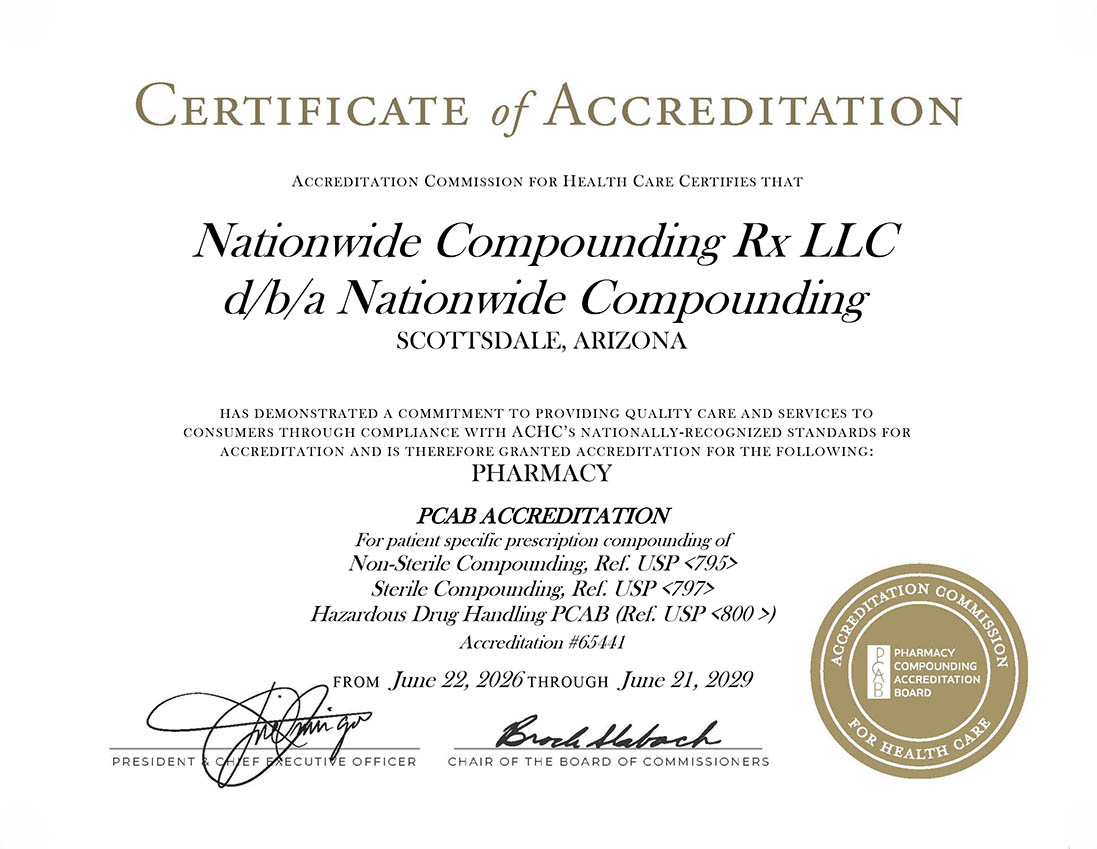
- PCAB accreditation
- USP 800 compliance
- High-grade chemicals sourced from FDA-inspected and cleared vendors
- Independent third-party testing for quality and consistency
Turnaround is typically 1–2 business days, with same-day pickup available for some medications at the pharmacy’s Scottsdale location. For Louisville clinics, fulfillment runs through nationwide shipping, subject to medication type and state regulations.
Care: Ongoing Partnership and Patient Support
The final stage is what separates a partner from a vendor. Post-fulfillment support includes refill management through both the Provider Portal and a separate Patient Portal, ongoing formulation adjustments as patient needs change, and continued communication as regulations evolve, including future USP updates. The relationship is clinical and continuous rather than a single transaction.
Who the Partnership Model Serves Across the Louisville Metro
The framework applies differently depending on practice type, so engagement is tailored to each setting.
Physicians and Specialty Practices
Prescribers frequently need non-standard dosages, recreations of discontinued strengths, or formulations free of dyes, fillers, preservatives, and allergens. With the median 503A pharmacy collaborating with about 150 prescribers, this is a proven, relationship-based model that scales across specialties without losing individual attention.
Med Spas and Weight-Loss Clinics
Nationwide Compounding Rx® offers GLP-1 and peptide support within the patient-specific 503A framework described above. After the 2026 delisting decisions, these practices benefit most from a pharmacy that is transparent about legal boundaries rather than one relying on ambiguous “compounded GLP-1” marketing.
Functional and Integrative Medicine Practices
BHRT and individualized protocol compounding are a core fit here. Adjustable formulas tied to lab-result-driven refills allow hormone therapy to evolve alongside each patient’s biomarkers.
Retail Pharmacy Central-Fill Partnerships
An often-overlooked opportunity involves Louisville retail pharmacies that need overflow or specialty compounding support without building in-house sterile or non-sterile capability. Some B2B compounders use reciprocal-referral models, in which the compounder refers patients back to the originating pharmacy once a prescription is filled. Central-fill offers a complementary path, letting independent Louisville pharmacies expand services while keeping their patient relationships intact.
Patient-Side Specialties Louisville Providers Can Offer Through This Partnership
Ultimately, strong partnerships exist to serve patients better. These are the specialties providers can extend to their Louisville patients.
Bioidentical Hormone Replacement Therapy (BHRT)
Customized hormone formulations address menopause, andropause, and other hormonal imbalances. Formulas can be adjusted with each refill based on lab results, supporting a more responsive treatment plan.
Pediatric Compounding
Medications are prepared with age- and weight-specific dosing for newborns through teens. Flavor options include cherry, bubblegum, tutti frutti, strawberry, marshmallow, and piña colada, among others, and formulations can be made free of dyes, fillers, and preservatives for Louisville families with sensitive children.
Dermatology Formulations
Custom topicals target acne, rosacea, eczema, psoriasis, atopic dermatitis, scarring, stretch marks, dark spots, and aging. Allergen-free and preservative-free options suit patients who react to commercial products.
Pain Management
Topical creams, gels, and ointments localize treatment, reducing systemic side effects and addiction risk. This approach is relevant to Louisville pain management and sports medicine practices seeking alternatives to oral medications.
Quality and Compliance Credentials Louisville Providers Should Verify
PCAB accreditation is the leading voluntary quality credential in compounding. It was established in 2007 by eight national pharmacy organizations, is now administered through ACHC, and has been described as the AMA-endorsed preferred standard for physician use. Even so, fewer than 1% of U.S. compounding pharmacies hold it.
Washington and Ohio require verifiable PCAB accreditation for nonresident pharmacy licensure, which makes it a useful benchmark for any provider evaluating a pharmacy’s multi-state credibility. USP 800 compliance and independent third-party testing round out the non-negotiable checkpoints for Kentucky-based practices in 2026.
Questions Louisville providers should ask before signing on with a compounding partner:
- Is the pharmacy PCAB accredited, and can that status be verified?
- Does it comply with the 2022 revisions to USP 795, 797, and 800?
- Where are active ingredients sourced, and are vendors FDA-inspected?
- Is finished product independently tested?
- What are standard turnaround times?
- What is the pharmacy’s licensing tier for Kentucky and for patients’ home states?
- How does it handle 503A-versus-503B boundaries for GLP-1 prescriptions?
How This Partnership Approach Differs From Local and National Alternatives
Local independents bring real strengths: community trust and long tenure, with founding dates of 1997 and 2005. Their public materials, however, show limited regulatory or credential messaging and no clearly structured onboarding process.
National 503A players offer broad state coverage and white-label language, but they offer minimal explanation of what the partnership process actually involves.
Nationwide Compounding Rx®’s Connect → Collaborate → Create → Care framework combines the strengths of both: credentialing and compliance rigor at a national level, paired with a clearly articulated, relationship-driven process. Its nationwide shipping and state-tiered licensing transparency also matter for Louisville providers whose patients relocate or require multi-state fulfillment.
Getting Started: What Louisville Providers Should Expect
The first steps are practical:
- Register for the Provider Portal to gain secure prescription submission and order tracking.
- Schedule an initial consultation to discuss specialty needs, patient population, and licensing status.
- Plan formulations collaboratively, including dosage forms, strengths, and allergen considerations.
Once orders begin, providers can expect 1–2 business day turnaround, with same-day pickup for some medications. Communication runs through secure portals, phone, and email, with email inquiries answered within one business day.
Onboarding timelines and compliance documentation may vary by practice type. A med spa launching a weight-management program, a physician office adding BHRT, and a retail pharmacy setting up central-fill each have different requirements.
Conclusion: Choosing a Compounding Partner, Not Just a Pharmacy
In 2026’s regulatory environment, with Kentucky enforcing the 2022 USP revisions and federal GLP-1 policy firmly reset, proximity and shipping speed are no longer enough. Louisville providers need a partner with a transparent process and verifiable compliance.
The Connect → Collaborate → Create → Care framework fills the process-clarity gap left by both local independents and national white-label players. The ultimate beneficiaries are patients who receive better-fitting BHRT, pediatric, dermatology, and pain management therapies because their providers chose a partner carefully.
Partner With Nationwide Compounding Rx
Louisville-area physicians, med spas, weight-loss clinics, functional medicine practices, and independent pharmacies can begin the Connect stage through the Provider Portal or the contact form at nationwidecompounding.com.
- Phone: (480) 499-8379
- Hours: Monday–Friday, 7:00 AM – 3:30 PM
- Response time: Inquiries answered within one business day
Patients seeking BHRT, pediatric, dermatology, or pain management compounding can ask their Louisville provider about partnering with Nationwide Compounding Rx®, bringing personalized medication within reach through a relationship built for 2026 and beyond.
Related Posts

This 2026 guide to the community compounding pharmacy in Lake Oswego covers more than an address and phone number. It breaks down Oregon's nonresident pharmacy rules, GLP-1 compounding enforcement, and USP compliance standards every patient should understand before having medication shipped.

Choosing a Lexington KY compounding pharmacy takes more than proximity and a star rating. This 2026 guide shows you how to verify Kentucky Board licensure, PCAB accreditation, and USP 795/797/800 compliance before trusting a provider with your prescription.

Central Ohio's booming population, aging demographics, and billion-dollar health system investments are driving unprecedented demand for personalized medication. This article explores what's fueling the rise in central Ohio compounding pharmacy needs in 2026 and how new regulations are reshaping access to quality care.

NYU Specialty Pharmacy offers strong outpatient care, but strict eligibility, in-network, and disease-state rules can block certain prescriptions. Discover the three key limitations and where New Yorkers can turn next in 2026.