
What Is Pharmaceutical Compounding? The Complete 2026 Guide
Introduction: Medicine Has Always Been Personal
Long before pills rolled off factory production lines in identical bottles, every medication was made by hand. A pharmacist would measure, mix, and tailor each remedy to the individual patient standing at the counter. There was no “one size fits all.” There was simply the patient, the ailment, and the skill of the person preparing the treatment.
That practice has a name: pharmaceutical compounding. Far from being a modern workaround or a fringe idea, compounding is the original form of medicine. It was temporarily displaced by the rise of industrial pharmaceutical manufacturing in the twentieth century and is now experiencing a genuine, data-supported renaissance driven by personalized medicine.
This guide covers everything a curious reader needs to understand: what compounding is, where it came from, how it works today, the regulatory framework that governs it, who benefits from it, the safety standards that protect patients, current market data, and how to identify a trustworthy compounding pharmacy. Readers may have first encountered the term from a physician, in news coverage of GLP-1 weight loss drugs, or while wondering why a prescription needs to be “specially made.” This article answers all of those questions.
Drawing on FDA guidance, peer-reviewed sources, and the latest market research, this guide also reflects the real-world expertise of Nationwide Compounding Rx®, a PCAB-accredited pharmacy in Scottsdale, Arizona, whose commitment to individualized patient care informs the perspective throughout.
What Is Pharmaceutical Compounding? The Core Definition
The FDA defines pharmaceutical compounding as a practice in which a licensed pharmacist, a licensed physician, or (in the case of an outsourcing facility) a person under the supervision of a licensed pharmacist combines, mixes, or alters ingredients of a drug to create a medication tailored to the needs of an individual patient.
In plain language, compounding means a trained pharmacy professional custom-builds a medication for one specific patient’s unique medical need. That might mean adjusting the dose, changing the form from a pill to a liquid, removing an allergen, or combining several drugs into a single formulation.
One distinction matters more than any other: compounded drugs are not FDA-approved. The FDA does not review their safety, effectiveness, or quality before they reach patients. This is a legal, well-understood reality rather than a scandal, and meaningful safeguards exist in place of federal pre-approval, as this guide will explain.
It is equally important to clarify what compounding is not. It is not the same as a generic drug, which is FDA-approved and bioequivalent to a brand-name product. It is not illegal. It is not experimental in any negative sense. It is not a loophole. The best modern framework for understanding compounding is “personalized medicine”: medications adjusted to the unique health requirements of each patient.
A few simple examples anchor the idea. Consider a child who cannot swallow a pill, a patient allergic to a dye in a commercial tablet, or an adult who needs a dose strength that no manufacturer produces. In each case, compounding provides the answer.
A Brief History of Compounding: From Ancient Apothecaries to the Modern Pharmacy
Understanding where compounding came from explains why it still matters and why it is resurging today.
Its roots reach deep into antiquity. Mesopotamian clay tablets from around 2600 B.C. record the earliest known pharmaceutical recipes. Egyptian papyri, notably the Ebers Papyrus of roughly 1550 B.C., document hundreds of compounded remedies. Ancient Chinese and Ayurvedic traditions similarly relied on individualized herbal preparation.
The pivotal figure is Claudius Galen (130 to 200 A.D.), the Greek-Roman physician credited with formalizing the practice of mixing multiple drugs to meet individual patient needs. He is the direct intellectual ancestor of modern compounding, and the term “Galenical pharmacy” persists in pharmaceutical science to this day.
During the Islamic Golden Age, from the tenth through thirteenth centuries, medieval apothecaries systematized compounding, introduced early quality standards, and separated the roles of physician and pharmacist, a division that still defines modern healthcare.
In America, the first drugstore opened in 1720 in Philadelphia as an apothecary run by Christopher Marshall. The Philadelphia College of Pharmacy, founded in 1821, was the first pharmacy school in the country. Every early American pharmacist was, by definition, a compounder.
Then came the displacement. The rise of industrial pharmaceutical manufacturing from the 1940s through the 1960s made mass-produced, standardized drugs cheaper, more consistent, and more widely available. Compounding fell from the dominant model to a specialized niche.
Today, personalized medicine, drug shortages, an aging population, and the rise of bioidentical hormone therapy have restored compounding to prominence. This is not a step backward; it is a sophisticated evolution of an ancient craft.
How Pharmaceutical Compounding Works Today
The workflow begins with a licensed prescriber, such as a physician, dentist, or nurse practitioner, who determines that a patient has a need no commercially available drug can meet. The prescriber writes a compounding prescription, and the compounding pharmacist prepares the customized medication.
A compounding pharmacist can make many types of customizations:
- Adjust the dose strength to a level no manufacturer produces
- Change the dosage form, for example from a tablet to a liquid or from an oral drug to a topical cream
- Remove allergens or inactive ingredients such as dyes, lactose, gluten, or sugar
- Combine multiple medications into a single formulation
- Add flavoring to improve palatability
- Replicate a discontinued medication
Common dosage forms include capsules, oral liquids and suspensions, transdermal creams and gels, troches (sublingual lozenges), suppositories, topical ointments, injectables (sterile compounding), and increasingly patient-friendly formats such as gummies.
Compounding is inherently collaborative. The pharmacist works closely with the prescriber to ensure the formulation meets the patient’s clinical needs and may adjust it at each refill based on updated lab results, a process especially relevant for hormone therapy. Modern facilities move quickly as well. Nationwide Compounding Rx®, for instance, offers a one to two business day turnaround on all medications, same-day pickup for some, and nationwide shipping to 47 states plus Washington, D.C.
A critical safety guardrail applies throughout: patients cannot simply request a custom medication. A valid prescription from a licensed prescriber is always required.
The Regulatory Framework: 503A vs. 503B — What Patients and Providers Need to Know
Compounding pharmacies were not federally regulated until 1997, under the FDA Modernization Act. The modern two-tier framework was established by the Drug Quality and Security Act of 2013, passed in the aftermath of a 2012 fungal meningitis outbreak that killed 64 people and was traced to a non-compliant compounding facility.
503A pharmacies (traditional compounding) are regulated primarily by state boards of pharmacy. They compound only in response to a valid patient-specific prescription, cannot produce large batches for office use, and must comply with USP standards chapters 795, 797, and 800.
503B outsourcing facilities voluntarily register with and are directly overseen by the FDA. They can produce medications in large quantities without patient-specific prescriptions for sale to healthcare providers, hospitals, and clinics, and must comply with current Good Manufacturing Practices (CGMP), the same standards applied to commercial manufacturers.
For most patients, the practical difference is straightforward: they interact with 503A pharmacies, where a doctor sends a prescription and the pharmacy prepares it. Healthcare facilities typically source from 503B outsourcing facilities.
The USP standards translate as follows. USP chapter 795 governs non-sterile compounding such as creams, capsules, and oral liquids. USP chapter 797 governs sterile compounding such as injectables, eye drops, and IV admixtures, with strict contamination controls. USP chapter 800 governs the handling of hazardous drugs to protect both staff and patients.
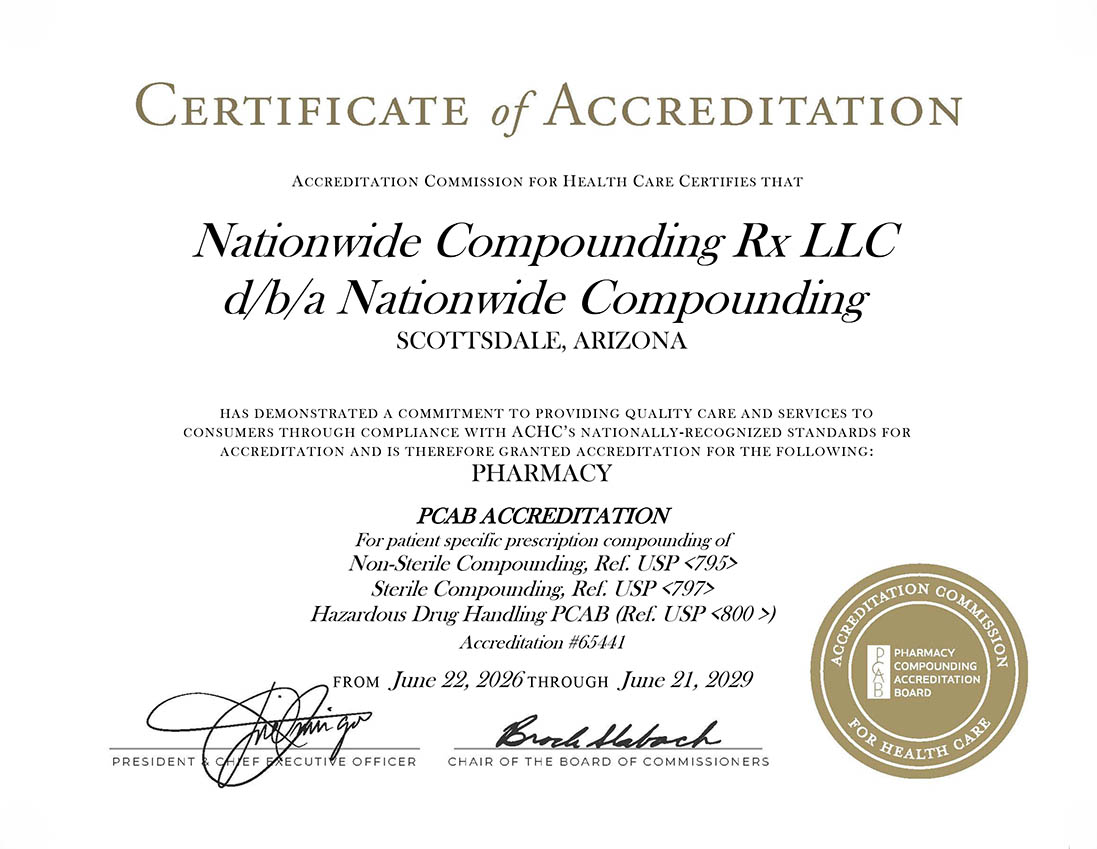
Beyond these baseline requirements sits PCAB accreditation, the gold standard for 503A pharmacies. The Pharmacy Compounding Accreditation Board independently evaluates pharmacies against rigorous safety and quality standards. Accreditation is voluntary, so pursuing and maintaining it signals a commitment to excellence beyond the regulatory minimum. Nationwide Compounding Rx® has maintained PCAB accreditation since its early days of operation and runs a USP chapter 800 compliant facility.
To address a recurring concern directly: while compounded drugs are not FDA-approved, they are legal, medically necessary for many patients, and subject to rigorous quality controls when prepared by an accredited, compliant pharmacy. The absence of FDA pre-approval is a regulatory distinction, not a safety verdict.
Who Needs Compounded Medications? Real-World Patient Scenarios
Compounding exists because real patients have real needs that mass manufacturing cannot meet.
Patients with Allergies or Intolerances to Commercial Drug Ingredients
Many commercial medications contain inactive ingredients such as lactose, gluten, artificial dyes, preservatives, or shellac coatings that can trigger reactions in sensitive patients. A compounding pharmacist can reformulate using only the active ingredient and hypoallergenic excipients. Consider a patient with celiac disease who needs a medication sold only in a gluten-containing tablet.
Patients Who Cannot Swallow Pills
Dysphagia, or difficulty swallowing, affects an estimated 15 million Americans, including many elderly patients and those with neurological conditions. Compounding can convert a tablet into an oral liquid, a transdermal cream, or a sublingual troche. This is also vital for children, who often will not swallow tablets but readily accept a flavored liquid or gummy.
Pediatric Patients Requiring Child-Appropriate Doses and Formulations
Many commercial drugs come only in adult doses. Pediatric dosing requires precise weight-based calculations that standard products cannot accommodate. Compounding pharmacists prepare exact pediatric doses in child-friendly forms, and premature infants in neonatal intensive care often depend on compounded medications not available commercially. Nationwide Compounding Rx® offers pediatric-friendly flavors including banana crème, cherry, grape, and tutti frutti to improve compliance.
Patients Needing Non-Standard Dose Strengths
Commercial drugs come in fixed strengths designed for the average patient. Some patients need more or less. Bioidentical hormone replacement therapy is the clearest example, requiring precise dosing based on lab results that can change at every refill. No commercial product can match that level of personalization.
Patients Affected by Drug Shortages or Discontinuations
The United States currently has over 200 drugs in active shortage. When the FDA officially recognizes a shortage, compounding pharmacies are legally authorized to compound that medication. More than half of compounding pharmacies surveyed in the APC 2025-2026 Snapshot reported compounding copies of FDA-approved drugs during active shortages. Compounding can also preserve access to permanently discontinued therapies.
Patients Benefiting from Combination Formulations
Some patients require multiple medications simultaneously. A compounding pharmacist can combine compatible drugs into one formulation, reducing pill burden and improving adherence. This is especially valuable in pain management, dermatology, and hospice or palliative care.
The Therapeutic Areas Where Compounding Makes the Greatest Difference
Compounding spans a remarkably broad spectrum of healthcare, from neonatal ICUs to veterinary clinics, and the U.S. market is growing at a 6.24% compound annual growth rate (CAGR).
Hormone Replacement Therapy (HRT) and Bioidentical Hormones (BHRT)
HRT and BHRT form the fastest-growing therapeutic segment, at a 7.86% CAGR, driven by demand for individualized treatments for menopause, andropause, and thyroid disorders. Bioidentical hormones are chemically identical to those the body produces. Nationwide Compounding Rx® specializes in BHRT for patients experiencing fatigue, mood swings, weight gain, hot flashes, and related conditions, with doses adjustable at each refill based on lab results.
Pain Management
Pain management is the largest segment, accounting for 31.23% of global market share in 2025. Compounded topical creams and gels deliver active ingredients directly to the site of pain, minimizing systemic side effects such as addiction risk, dizziness, and nausea. Nationwide Compounding Rx® offers personalized pain combinations designed in collaboration with the prescriber.
Dermatology
Dermatological compounding addresses rosacea, acne, aging, scarring, stretch marks, dark spots, eczema, psoriasis, and atopic dermatitis. Pharmacists tailor the vehicle, active ingredient concentration, and combinations to each patient’s skin type while eliminating irritating preservatives or fragrances.
Pediatrics
Pediatric compounding solves the mismatch between adult formulations and the needs of infants and children through weight-appropriate dosing, palatable flavors, allergen-free options, and life-sustaining medications for premature infants.
Sports Medicine
Athletes often need specialized protocols for injury treatment, recovery, and performance. Compounding enables targeted topical anti-inflammatories, precise hormone therapies, and combination treatments built around individual recovery timelines. Nationwide Compounding Rx® serves athletes and sports medicine practices with such customized formulations.
Weight Management
Weight management gained enormous visibility during the GLP-1 shortage. Beyond GLP-1s, pharmacies prepare HCG and medical-grade appetite suppressants. Nationwide Compounding Rx® is the exclusive provider of RM3® medication for Red Mountain Weight Loss®.
Other Key Therapeutic Areas
Compounding also plays important roles in oncology, ophthalmology, dentistry, hospice care, and veterinary medicine. The global animal drug compounding market was estimated at $1.68 billion in 2025 and is projected to grow at an 8.32% CAGR through 2035. National Academies data confirms compounding’s use across men’s and women’s health, immunology, otolaryngology, and neurology.
The Compounding Industry by the Numbers: Scale, Scope, and Growth
Compounding is often perceived as niche, but the data tells a different story.
- U.S. market size: approximately $6.98 billion in 2025, projected to reach $7.42 billion in 2026 and $12.79 billion by 2035 at a 6.24% CAGR (Towards Healthcare Research, 2026).
- Global market size: roughly $15.83 to $16.78 billion in 2025 to 2026, projected to reach $22.08 billion by 2031 at approximately 5.7% CAGR (Mordor Intelligence, 2026). North America holds 37% to 56% of global revenue.
- Prescription volume: compounded prescriptions account for an estimated 1% to 3% of all U.S. prescriptions, representing millions of patients.
- Pharmacy-level data (APC 2025-2026 Snapshot): the median 503A pharmacy dispenses approximately 350 compounded prescriptions weekly, collaborates with roughly 150 prescribers, and prepares about 100 unique formulations each week.
- Workforce expertise: compounding pharmacists average 19 years of experience; technicians average more than 12 years.
- Sterile vs. non-sterile: sterile medications dominate the U.S. market at roughly 57% to 60% revenue share; oral medications hold 36% to 49%.
Growth is fueled by personalized medicine demand, an aging population, rising chronic disease, persistent drug shortages, and the expansion of telehealth.
The GLP-1 Compounding Saga: What It Revealed About Compounding’s Role and Risks
A complete guide must address the most high-profile event in recent compounding history honestly.
Semaglutide (Ozempic and Wegovy) and tirzepatide (Mounjaro and Zepbound), GLP-1 receptor agonists approved for type 2 diabetes and obesity, experienced severe supply shortages beginning in 2022 as demand outpaced manufacturing. Once the FDA officially recognized these shortages, compounding pharmacies were legally permitted to compound the medications, producing them at $150 to $300 per month compared to $1,000 or more for branded versions. This provided access for millions who could not otherwise afford or obtain them.
The benefits came with risks. As demand surged, some compounding pharmacies and many non-pharmacy online sellers produced substandard, mislabeled, or counterfeit products. As of May 21, 2026, the FDA had received more than 1,700 adverse events associated with compounded semaglutide and tirzepatide, including dosing errors.
The regulatory response followed. The FDA declared the shortages resolved in late 2024 and early 2025, and compounding grace periods ended by May 2025. On April 30, 2026, the FDA proposed to formally exclude semaglutide, tirzepatide, and liraglutide from the 503B bulks list, with a public comment period through June 29, 2026.
The broader lesson is twofold: compounding delivers essential access during genuine shortages, and choosing an accredited, compliant pharmacy is critical. The adverse events were predominantly linked to unregulated online sellers, not to PCAB-accredited, state-licensed pharmacies. Nationwide Compounding Rx® operates strictly within all applicable state and federal guidelines, sources only from FDA-inspected vendors, and maintains PCAB accreditation, representing compounding done right.
The 2025-2026 Regulatory Landscape: What’s Changing and Why It Matters
Regulatory changes directly affect what medications are available, from which pharmacies, and in which states.
At the federal level, the Drug Shortage Compounding Patient Access Act of 2025 (H.R. 5316), introduced by the only two pharmacists in Congress, aims to codify compounding pharmacies’ authority to address drug shortages and reduce dependence on foreign suppliers. It is supported by APC, APhA, and NCPA. The SAFE Drugs Act of 2025 was introduced to strengthen federal oversight, including expanded recordkeeping requirements.
At the state level, California adopted new Board of Pharmacy rules redefining “essentially a copy,” and Florida introduced SB 860 and HB 877 imposing new API sourcing requirements. This state variation means availability can differ by location. Nationwide Compounding Rx® ships to 47 states plus Washington, D.C., but does not currently serve Alabama, California, North Carolina, or South Carolina, partly reflecting this complex regulatory environment.
The key takeaway: the regulatory landscape is active and evolving. Regulatory intensification reflects the industry’s growth and visibility, not an indictment of compounding. The goal is to protect patients while preserving access to medically necessary medications.
Safety, Quality, and What to Look for in a Compounding Pharmacy
A common question deserves a direct answer: if compounded drugs are not FDA-approved, how can patients know they are safe? Reputable pharmacies operate within a robust quality assurance framework.
USP Standards: The Quality Backbone of Compounding
- USP chapter 795 governs non-sterile compounding, setting standards for ingredient quality, equipment, documentation, and beyond-use dating.
- USP chapter 797 governs sterile compounding, requiring cleanroom environments, gowning protocols, and rigorous contamination controls.
- USP chapter 800 governs hazardous drug handling, protecting staff and patients. Nationwide Compounding Rx® operates a USP chapter 800 compliant facility.
Compliance is not optional for licensed pharmacies; it is required by state boards and verified through inspection.
PCAB Accreditation: The Gold Standard
PCAB independently evaluates pharmacies against rigorous safety, quality, and practice standards well beyond minimum licensing. Because accreditation is voluntary, pursuing and maintaining it signals a proactive commitment to excellence. The process involves on-site inspection, policy review, staff competency assessment, and ongoing monitoring. Nationwide Compounding Rx® has maintained PCAB accreditation since its early days of operation. When evaluating a pharmacy, patients should ask directly whether it holds PCAB accreditation and complies with the relevant USP chapters.
Ingredient Sourcing and Facility Standards
A compounded medication is only as good as its ingredients. Reputable pharmacies source active pharmaceutical ingredients exclusively from FDA-inspected and cleared vendors, a non-negotiable standard that Nationwide Compounding Rx® upholds. A USP chapter 800 compliant facility eliminates cross-contamination, and modern technology such as robotics and precision measurement equipment reduces human error.
Red Flags to Watch For
Warning signs include:
- No PCAB accreditation or state pharmacy license
- Inability to document USP compliance
- Sourcing APIs from non-FDA-inspected vendors
- Offering to compound without a valid prescription
- Therapeutic claims that sound too good to be true
- No pharmacist available for clinical questions
The GLP-1 situation reinforced a clear lesson: most adverse events were linked to sellers operating entirely outside the pharmacy regulatory framework. Patients should verify license and accreditation status through their state board and the PCAB website before ordering.
Compounding vs. Commercial Pharmacy: Understanding the Key Differences
- FDA approval status: commercial drugs are FDA-approved; compounded drugs are not, though they remain legal and subject to state and USP oversight.
- Standardization vs. customization: commercial drugs come in fixed doses for the average patient; compounded drugs are made for a specific individual.
- Compounding vs. generics: a generic is an FDA-approved bioequivalent copy of a brand-name drug; a compounded medication is not FDA-approved. These are fundamentally different categories.
- Scale: manufacturers produce millions of identical units; a compounding pharmacy prepares individual prescriptions (503A) or smaller batches (503B).
- Insurance coverage: commercial drugs are typically covered; compounded medications may or may not be, depending on the plan and clinical justification.
- When to use each: commercial drugs suit the vast majority of patients. Compounding is appropriate only when a documented need cannot be met commercially.
A crucial note applies here: if a commercially available drug meets a patient’s needs, that drug should be used. Compounding is a solution for specific unmet needs, not a blanket alternative to the commercial pharmaceutical system.
The Future of Compounding: Personalized Medicine, Technology, and What’s Next
Compounding began as the only form of pharmacy, was temporarily displaced by industrial manufacturing, and is now being restored by personalized medicine and technology.
Advances in genomics, pharmacogenomics, and precision diagnostics are enabling clinicians to prescribe medications tailored to each patient’s biology, and compounding is the delivery mechanism for that personalization. The aging U.S. population, with its complex medication needs and intolerances, further drives demand.
Technological innovations are reshaping the field: robotics reducing contamination in sterile compounding, e-prescribing improving workflow, nanoencapsulation improving bioavailability, AI-powered formulation tools optimizing ingredient combinations, and telepharmacy platforms expanding access. Nationwide Compounding Rx®’s nationwide shipping positions it at the forefront of the telehealth trend.
The 503B outsourcing segment is expected to grow fastest in the U.S., driven by demand for large-batch sterile medications, BHRT, and weight management formulations. The intensifying regulatory environment is ultimately strengthening the industry by removing non-compliant operators and building confidence in accredited facilities.
From Galen’s apothecary to a PCAB-accredited facility shipping customized medications to 47 states, the art and science of compounding has never been more sophisticated, more necessary, or more aligned with the future of medicine.
Frequently Asked Questions About Pharmaceutical Compounding
Is compounding legal? Yes. It is a legal, federally recognized practice regulated under the Drug Quality and Security Act of 2013 and overseen by state boards of pharmacy and, for 503B facilities, the FDA.
Are compounded medications safe? Medications prepared by licensed, PCAB-accredited pharmacies operating under USP standards are subject to rigorous quality controls. As with any medication, risks exist, particularly when sourced from non-compliant or unaccredited facilities.
Do I need a prescription? Yes. Compounded prescription medications require a valid prescription from a licensed prescriber.
Will my insurance cover it? Coverage varies by plan and medication. Some compounded medications are covered; others are not. Patients should check with their insurer and prescriber.
How is compounding different from a generic drug? A generic is an FDA-approved bioequivalent copy of a brand-name drug. A compounded medication is custom-prepared and not FDA-approved. They are fundamentally different.
How does a patient know if they need a compounded medication? The prescriber will determine clinical appropriateness. Common reasons include allergies to commercial ingredients, inability to swallow standard forms, need for a non-standard dose, or a drug shortage.
What should patients look for in a compounding pharmacy? PCAB accreditation, USP compliance (chapters 795, 797, and 800 as applicable), state licensure, FDA-inspected vendor sourcing, and a pharmacist available for clinical questions.
Does Nationwide Compounding Rx® ship to all states? It ships to 47 states plus Washington, D.C. The states not currently served are Alabama, California, North Carolina, and South Carolina. Patients should contact the pharmacy directly to confirm availability.
Conclusion: The Ancient Art, Modernized
From Mesopotamian clay tablets to PCAB-accredited facilities, the fundamental purpose of compounding has never changed: to give each patient the medication they specifically need. It is legal, medically necessary for millions, subject to rigorous quality standards when performed by accredited pharmacies, and growing rapidly as personalized medicine becomes the new standard of care.
Compounding is not right for every patient or every situation. It is a specialized solution for specific unmet needs, and understanding when and why to use it is the first step toward better, more personalized healthcare. The best compounding pharmacies combine decades of expertise, modern technology, rigorous compliance, and a genuine commitment to individualized care. For patients and providers ready to explore whether compounded medications fit their needs, Nationwide Compounding Rx® offers the expertise, accreditation, and nationwide reach to serve as a trusted partner.
Ready to Explore Personalized Medication? Partner with Nationwide Compounding Rx®
Whether a patient is wondering if their medication needs can be met through compounding, or a healthcare provider is seeking to expand the personalized care options available to patients, Nationwide Compounding Rx® is ready to help.
The pharmacy is PCAB-accredited, USP chapter 800 compliant, staffed by professionals with 40 years of combined experience, and capable of a one to two business day turnaround with nationwide shipping to 47 states plus Washington, D.C. Its therapeutic expertise spans BHRT, pain management, dermatology, pediatrics, sports medicine, and weight management.
Contact Nationwide Compounding Rx®:
- Phone: 480-499-8379 or toll-free 1-833-650-9836
- Website: www.NationwideCompounding.com
- Location: 14000 N. Hayden Rd., Suite 104, Scottsdale, AZ 85260
- Hours: Monday through Friday, 7:00 a.m. to 3:30 p.m. (fax available for prescription receipt)
At Nationwide Compounding Rx®, the centuries-old art of compounding meets modern science, rigorous standards, and a genuine belief that every patient deserves a medication made for them, not for the average.
Related Posts

Searching for Las Colinas Pharmacy Compounding & Wellness in Irving, TX? This 2026 guide gives you the address, hours, and phone number up front, then breaks down the accreditation and safety standards DFW patients should check before trusting any compounding pharmacy with hormone, peptide, or custom medication needs.

Searching for Jefferson Specialty Pharmacy turns up two unrelated organizations—one in Pennsylvania, one in Washington State. This guide clarifies which is which and explains what to do in 2026 when a prescribed medication can't be filled by either.

Searching for Marty's Compounding Pharmacy but not sure if a local Mississippi storefront fits your needs? This guide compares Marty's Pharmacy & Compounding Center to nationwide compounding options using a five-point credential checklist covering accreditation, testing, and shipping licenses in 2026.

The term 'board of specialty pharmacy' actually refers to four distinct organizations, each serving a different purpose. This article breaks down BPS, SPCB, state boards, and PCAB to reveal which body truly governs compounding pharmacy quality in 2026.