Compounding Pharmacy Asheville: GLP-1 Rules You Need in 2026
Introduction: Is Compounded Semaglutide Still Legal in Asheville Right Now?
Patients searching for a compounding pharmacy in Asheville often want a simple yes or no on compounded GLP-1 medications such as semaglutide and tirzepatide. In 2026, the honest answer is more complicated.
Two forces now shape access. The first is federal: in April 2026, the FDA proposed removing semaglutide, tirzepatide, and liraglutide from the 503B bulk-substances list. The second is state-level: North Carolina has taken a restrictive regulatory stance on compounded weight-loss drugs since 2023.
This article explains what is legal, what is required, and how patients can verify any Asheville-area pharmacy before trusting it with a GLP-1 prescription. Most local content covers general PCAB verification advice; this guide focuses specifically on the GLP-1 question, which few local resources have addressed.
This article is for general education and is not legal or medical advice. Patients should confirm current rules with their prescriber and the North Carolina Board of Pharmacy.
The Short Answer: Compounded GLP-1s Are Still Possible in NC, But the Bar Is Much Higher in 2026
Compounding semaglutide or tirzepatide for an individual patient in North Carolina remains legal. The conditions, however, are much narrower than they were in 2023 and 2024.
Two requirements must both be met:
- The prescriber documents a “clinically significant difference” between the compounded preparation and the FDA-approved product for that specific patient.
- The dispensing pharmacy holds a current, active North Carolina Board of Pharmacy permit (or a nonresident permit, if it is located out of state).
The shortage-based justification that once allowed broad compounding no longer applies. The FDA’s semaglutide shortage grace periods ended on April 22, 2025, for state-licensed 503A pharmacies and May 22, 2025, for 503B outsourcing facilities. Since then, “shortage” has not been a valid legal basis for compounding these drugs.
The sections below explain each requirement in plain language.
What Changed in 2026: The FDA’s April Proposal to Strip GLP-1s from the 503B Bulk List
Outsourcing facilities registered under Section 503B of federal law can compound medications in larger volumes than traditional pharmacies. To compound from raw bulk ingredients, they generally rely on a list of approved bulk drug substances. That list effectively determines which drugs these facilities may produce at scale.
In April 2026, the FDA proposed removing semaglutide, tirzepatide, and liraglutide from the 503B bulk-substances list entirely. The agency concluded there was no continued clinical need for bulk compounding of these drugs.
The practical effect is significant. Many 503B facilities depended on this pathway to supply compounded GLP-1s across the country, including to North Carolina. Removing these substances closes that route and further narrows nationwide access.
As of late 2026, this remains a proposal rather than a final rule. Even so, pharmacies and prescribers are already adjusting their practices in anticipation, and patients may notice fewer available options as a result.
North Carolina’s Unusually Restrictive Posture on Compounded Weight-Loss Drugs
North Carolina is one of a handful of states, alongside Louisiana, Mississippi, and West Virginia, whose regulators have taken explicit enforcement interest in compounded weight-loss drugs since 2023. As NBC News reported, regulators in these states said they were aware that some compounding pharmacists were using a different form of semaglutide that is not approved by the FDA. The concern centered on non-FDA-approved salt forms of semaglutide, such as semaglutide sodium and semaglutide acetate.
North Carolina also uses a two-board structure:
- The North Carolina Medical Board governs the prescribers who write GLP-1 prescriptions.
- The North Carolina Board of Pharmacy governs which pharmacies may legally compound and dispense those prescriptions.
This dual oversight explains why Asheville patients often encounter more friction than patients in less-regulated states. Both the prescription and the pharmacy must satisfy separate regulators.
A Teaching Moment: Why Accreditation Alone Doesn’t Guarantee a Pharmacy Can Ship GLP-1s to North Carolina
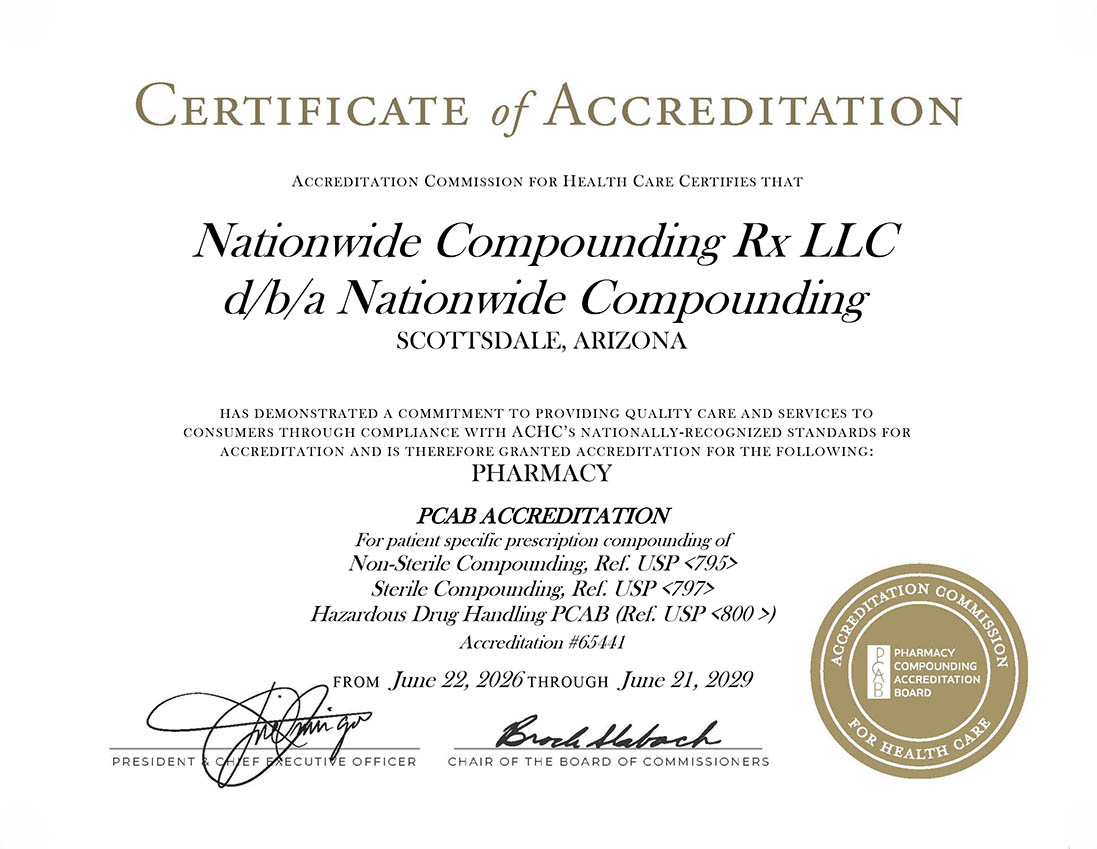
Nationwide Compounding Rx®, based in Scottsdale, Arizona, offers a useful example of why accreditation and state licensure are two separate questions. The pharmacy is PCAB-accredited and USP <800> compliant, uses independent third-party testing, and sources chemicals from FDA-inspected and cleared vendors. Like many compounding pharmacies, it ships nationwide under a multi-tier state licensing system, with availability for sterile and non-sterile preparations varying by state. Patients should not assume that any accredited pharmacy, including Nationwide Compounding Rx, is automatically licensed to ship into North Carolina; licensure status should always be confirmed directly.
This is not a quality issue. It reflects a legal reality: even a fully accredited, reputable national pharmacy cannot dispense into a state without that state’s specific license.
The broader lesson for patients is that two separate questions must both be answered:
- Accreditation (PCAB, USP <795>/<797>/<800>) answers: Is this a quality pharmacy?
- Licensure answers: Can this pharmacy legally serve patients in my state?
A pharmacy can satisfy the first and still fail the second. That distinction leads directly to North Carolina’s nonresident-permit rule.
The NC Board of Pharmacy Nonresident-Permit Rule, Explained
Any out-of-state pharmacy that ships prescriptions into North Carolina must hold a nonresident pharmacy permit from the North Carolina Board of Pharmacy. This permit is separate from the pharmacy’s home-state license.
Without it, a pharmacy cannot legally serve North Carolina patients, no matter how strong its accreditation. For this reason, patients should verify nonresident-permit status directly with any pharmacy under consideration rather than assuming coverage based on reputation alone.
Patients considering any pharmacy that plans to ship a prescription should ask directly whether it holds an active North Carolina nonresident permit, then confirm the answer independently through the North Carolina Board of Pharmacy’s online license lookup.
The “Clinically Significant Difference” Documentation Requirement
Federal and state rules generally prohibit compounding a drug that is “essentially a copy” of an FDA-approved product. The exception applies when there is a documented clinical reason the approved product will not work for a specific patient.
Examples that might qualify include:
- An allergy or sensitivity to an inactive ingredient in the approved pen
- A need for a different dosage form, such as a non-injectable option
- A dosing strength that is not commercially available
This documentation must come from the prescriber, not the pharmacy, and it must be patient-specific. A blanket clinic policy, or reasoning based on convenience or cost, does not satisfy the requirement.
The requirement carries more weight now because the shortage-based exception expired in 2025. Every compounded GLP-1 prescription written in North Carolina since then has faced this higher compliance bar.
How to Confirm an Asheville-Area Pharmacy Is Actually Authorized to Dispense Compounded GLP-1s Today
The following four-step checklist is designed for patients evaluating any Asheville-area compounding pharmacy specifically for GLP-1 medications, not only for BHRT or pediatric compounding.
A pharmacy may have earned decades of local trust for hormone therapy, pediatric medications, or veterinary preparations. That history does not automatically mean it is currently set up, staffed, or sourcing-compliant for GLP-1 compounding under 2026 rules.
Step 1: Ask Directly Whether They Currently Compound Semaglutide/Tirzepatide
Patients should call and ask the specific question rather than relying on a website’s general service list. GLP-1 availability can change from month to month as regulations shift.
Useful follow-up questions include:
- Which active ingredient and salt form does the pharmacy use?
- Is that ingredient sourced from an FDA-registered facility?
A clear, confident answer is a good sign. Hesitation or vague responses warrant caution.
Step 2: Verify PCAB Accreditation and USP <795>/<797>/<800> Compliance
PCAB accreditation, administered by ACHC, confirms that a pharmacy complies with three key standards:
- USP <795>: non-sterile compounding
- USP <797>: sterile compounding (relevant for injectable GLP-1s)
- USP <800>: hazardous drug handling
Updated, more stringent USP <795> and <797> standards took effect June 1, 2024. USP <800> became enforceable November 1, 2023. Yet according to a 2024 industry report, only 46% of hospitals reported full USP <800> compliance. Verified compliance is a real differentiator, not a formality.
Patients can ask the pharmacy for its current PCAB certificate information or check ACHC’s public accreditation directory.
Step 3: Confirm Your Prescriber Can Provide the Clinically-Significant-Difference Documentation
Patients should ask their prescriber, whether at a BHRT clinic, an integrative practice, or a primary care office, whether the provider is prepared to document the specific medical justification required under current rules.
Asheville has a dense BHRT and HRT provider network, including Biote-certified practices, Blue Sky MD, Biltmore Restorative Medicine, Hormone Harmony Clinic, and Mountain Radiance. These practices often write compounded prescriptions. However, the compounding pharmacy serves as the fulfillment layer and must independently confirm compliance. A compliant prescriber does not substitute for a compliant pharmacy, and the reverse is also true.
Step 4: Check NC Board of Pharmacy Licensure Status Yourself
The North Carolina Board of Pharmacy offers a public license verification tool on its website. Patients can:
- Search by pharmacy name or permit number.
- Confirm the permit type (in-state or nonresident).
- Check that the status is active and in good standing.
- Look for any listed disciplinary actions.
This step applies even to pharmacies that have operated locally for decades. Ongoing licensure is not guaranteed by history alone.
Spotlight: What We Know About Asheville Compounding Pharmacy’s Current Scope
Asheville Compounding Pharmacy (ACP), located at 760 Merrimon Ave, is the area’s long-tenured, family-owned option. Sources cite its service to the region since 1992 or 1993, and the pharmacy describes itself as having served Asheville and western North Carolina for over 25 years.
ACP’s well-documented service lines include:
- Hormone therapy for men and women
- Sexual health
- Pediatric and veterinary compounding
- Natural supplements
- Preservative-free flu and COVID immunizations
The pharmacy also lists sterile compounding capabilities, including eye drops, injections for erectile dysfunction, subcutaneous B12 injections, and intravenous vitamin preparations, along with adrenal fatigue and T3/T4 thyroid support.
Published information about ACP emphasizes hometown trust and service breadth. It does not prominently detail current GLP-1 compounding or call out PCAB or USP credentials. This is a gap in public information, not a claim that ACP does or does not compound GLP-1s today. It is the reason patients should call and work through the four-step checklist directly rather than assume authorization based on reputation alone.
Red Flags to Watch For When Shopping for Compounded GLP-1s in 2026
Patients should be cautious when they encounter any of the following:
- “Identical to” or “just like” brand-name claims. Compounded semaglutide is not FDA-approved and is not the same as the brand-name product. On September 9, 2025, the FDA sent Hims & Hers a warning letter, part of a broader enforcement effort targeting more than 100 drug advertisers, faulting the company for claims about the similarity of compounded products to Ozempic and Wegovy.
- Unwillingness to explain the justification. A provider or pharmacy that cannot explain its clinically-significant-difference reasoning or its North Carolina permit status is a signal to look elsewhere.
- Out-of-state shipping without a verifiable NC permit. Any pharmacy shipping compounded GLP-1s into North Carolina must hold a nonresident permit that patients can confirm through the Board of Pharmacy.
- Vague answers about salt forms. Non-FDA-approved salt forms of semaglutide are the specific quality concern North Carolina and other state boards have flagged since 2023.
Why This Matters More in Asheville: A Wellness-Driven, Health-Conscious Community
In 2026, EatingWell named Asheville the #1 Best Wellness Town in America, citing air and water quality, walkability, access to farmers’ markets, and proximity to nature. The ranking reflects a community where interest in wellness, weight management, and integrative therapies runs high.
This identity has deep roots. Asheville has served as a mountain retreat since the late 19th century, when doctors first sent patients there for the restorative mountain air.
The practical implication cuts both ways. High demand and a dense BHRT and integrative-medicine provider network give patients genuine options, but they also increase exposure to platforms operating in regulatory gray areas. For a city of roughly 93,700 residents, within a metro area of more than 400,000, careful verification matters even more than in less health-focused markets.
Conclusion: Verify First, Then Trust
Compounded GLP-1s remain legally obtainable in Asheville in 2026, but only when three conditions align: a pharmacy with current North Carolina licensure, PCAB and USP compliance, and a prescriber willing to document clinical necessity.
Reputation and longevity, such as ACP’s 25-plus years of local service, are valuable trust signals. They are not substitutes for direct, current verification of GLP-1-specific authorization.
The distinction between accreditation and state licensure, illustrated by pharmacies like Nationwide Compounding Rx that operate under multi-tier state shipping systems, models the kind of transparency every patient should expect from any pharmacy under consideration. Patients should always confirm a pharmacy’s specific North Carolina licensure status directly rather than assume it based on accreditation alone.
Take the Next Step: Verify Before You Fill
Before filling any compounded GLP-1 prescription locally, patients should complete the four-step checklist:
- Confirm the service: Ask whether the pharmacy currently compounds semaglutide or tirzepatide, and which salt form it uses.
- Check credentials: Verify PCAB accreditation and USP <795>/<797>/<800> compliance.
- Confirm documentation: Make sure the prescriber can document a clinically significant difference.
- Look up licensure: Verify active status through the North Carolina Board of Pharmacy.
Readers in states where Nationwide Compounding Rx is licensed can explore its PCAB-accredited, USP <800>-compliant compounding services, including its GLP-1/peptide support offerings, and its “Connect, Collaborate, Create, Care” provider partnership model as a benchmark for quality and transparency. Providers and patients with questions about compounding standards can reach the team through its secure provider or patient portal, or by phone at (480) 499-8379, Monday through Friday, 7:00 AM to 3:30 PM.
For Asheville-specific licensure questions, the North Carolina Board of Pharmacy remains the authoritative source.
Related Posts

Searches for Anasa Personalized Medicine reviews turn up thin directory listings that miss the practice's 2026 closure. This article verifies what's known about the shutdown and offers a due-diligence framework for vetting personalized medicine providers and their compounding pharmacies.

Compounded tirzepatide remains legal in 2026, but only under strict new rules. This guide breaks down the current regulatory status of tirzepatide compounding pharmacy practices, explains the legal tests pharmacies must meet, and gives patients a clear framework for evaluating safety and compliance.
Austin's compounding pharmacy market is crowded with long-standing local names, but proximity and reputation don't guarantee quality or safety. This guide breaks down the regulatory credentials—PCAB accreditation, TSBP licensing, USP compliance, and 503A status—that truly set an Austin compounding pharmacy apart.

Integrity Rx Specialty Pharmacy has a corporate history most patients never see. This article traces its journey from founder Jeffrey Karp to BelHealth Investment Partners and VFP Pharmacy Group's 2026 ownership structure, explaining what the consolidation means for patients filling fertility prescriptions.